Faeries
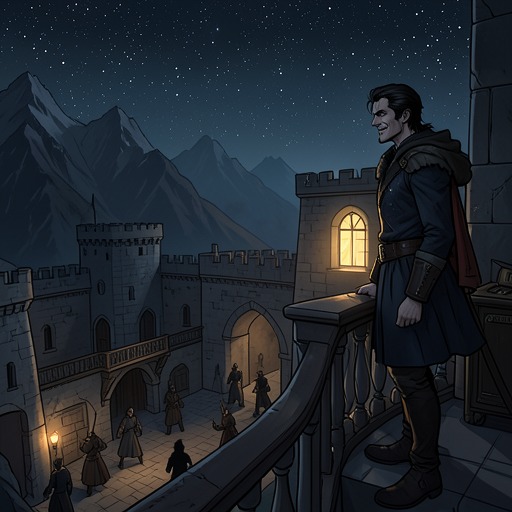
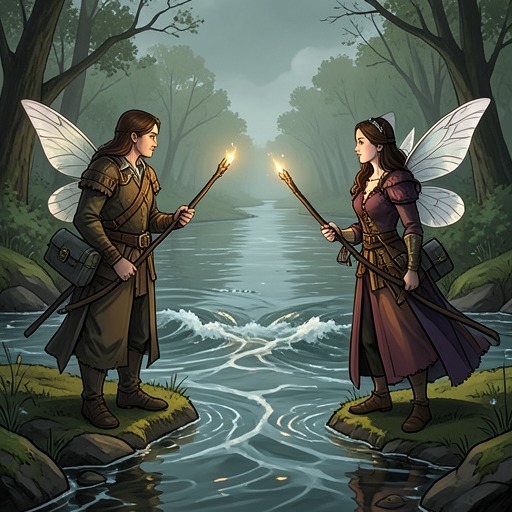
A Court of Thorns and RosesFaeries are the broader supernatural inhabitants of Prythian and the northern lands beyond the Wall, distinct from but inclusive of the more powerful High Fae. To human communities, they are remembered as former overlords, feared as creatures capable of crossing the boundary between realms, and encountered through rumor, violence, commerce, worship, and political domination. Their presence gives the Wall its meaning: it is both a historical settlement and a fragile defense against a people whose power humans believe they cannot match.
Identity and Historical Position
Faeries once enslaved human beings for millennia, compelling them to build civilizations and temples through their labor. Human rebellion eventually produced the War, a conflict so destructive that six mortal queens negotiated the Treaty to end the slaughter. Under that settlement, the northern territories remained with the High Fae and faeries, while mortals were confined to the South and separated from the immortal realm by the Wall. The arrangement ended open war but preserved a profound imbalance: humans retained a restricted territory and little effective means of defense, while faerie societies kept their magic and political power.
The faerie world is not presented as a single unified kingdom. Some territories are empires, others are governed by kings and queens, and Prythian is divided among the Seven High Lords. These rulers are described in human legend as powerful enough to level buildings, break armies, and kill before a victim can react. The hierarchy therefore contains its own distinctions: High Fae stand at the apex of faerie power, while faeries encompass the wider population of supernatural beings living under or around that political order.
The Wall and Human Fear
For the humans living near Prythian, the Treaty offers security more in theory than in practice. Their territory is too small and poor to maintain a standing army, so villagers rely on the old agreement and on protective customs whose effectiveness they doubt. Human children are taught from infancy that a High Fae can turn bones to dust from a hundred yards away, even though Feyre Archeron has never personally witnessed such a feat. Market stalls sell charms, iron, baubles, and incantations against faerie attack, but these defenses are understood to provide, at best, a few moments to prepare for flight.
The fear is also classed and embodied. Wealthy landowners can hire mercenaries to guard estates bordering Prythian, while poorer villagers must depend on inherited warnings and cheap protective objects. Nesta Archeron, Elain Archeron, and Isaac Hale wear iron bracelets or cuffs when they leave the cottage; Feyre Archeron refuses one offered by Isaac because it would make their ambiguous relationship feel like a permanent transaction. Such details show how faerie danger enters ordinary human life not only as a supernatural possibility but as a material economy of weapons, charms, borders, and inherited habits.
The Wall itself is neither wholly secure nor wholly permeable. Feyre Archeron learns that it can be crossed through breaches large enough for lethal creatures to enter human territory, while rumors claim that faeries move through holes in its wards. Later, when she reaches the boundary on horseback, she encounters an invisible barrier that stops her horse and prevents her from passing. The contradiction is central to the faeries’ role in the story: the border appears solid to the powerless, yet remains penetrable to those with the authority or magic to use it.
Contact, Glamour, and the Spring Court
Human contact with faeries is shaped by unequal forms of visibility. The Children of the Blessed publicly worship the High Fae, treating them as divine figures, but Feyre Archeron rejects that language because humans once lived under faerie overlords who were neither gods nor benevolent rulers. In the Spring Court, she encounters a different distortion: hundreds of High Fae gather during Calanmai wearing masks, while a glamour prevents her from perceiving their features clearly. When she looks directly at them, their faces dissolve into blurred color and shadow; they become more legible only at the edge of her vision.
This glamour turns faerie identity into an unstable spectacle. The gathered beings are physically present, yet their faces are withheld, making the crowd appear simultaneously populous and anonymous. Feyre Archeron enters concealed beneath a hood, worried that smoke and the scents of High Fae and faeries will not hide her human smell. The scene reverses the human experience of faerie danger: instead of merely imagining an unseen supernatural population beyond the Wall, she moves through that population while her own identity remains concealed and vulnerable.
Her first sustained experience of Prythian also unsettles the inherited human image of faeries as nothing but predators. After being taken across the Wall, Feyre Archeron finds a peaceful manor, a bedroom larger than her entire cottage, and a landscape without immediate screams, weapons, or slaughter. Yet the calm does not erase the power imbalance. She still understands herself as prey, and even a servant such as Alis may possess enough power to kill her. Faerie civility therefore functions as a condition of uncertainty rather than proof of safety.
Political Subjection and Amarantha’s Rule
Faeries are also the population through which political conquest becomes visible. Amarantha, formerly the King of Hybern’s most lethal general, fought in the War against mortals and against High Fae and faeries who defended them. After the Treaty, she killed her own slaves rather than release them. Later, she presented herself to the High Lords as a reforming emissary, the Never-Fading Flower, using promises of trade, communication, and shared resources to gain their trust.
Her diplomatic movement among the courts concealed an imperial strategy. The trade ships that connected Hybern and Prythian also carried Amarantha’s personal forces. Once she had spent fifty years building influence, she trapped the Seven High Lords at a ball held in her honor and drugged their wine with a potion stolen from the King of Hybern’s spell book. The potion exposed their magic, allowing her to extract much of their power from their bodies. With the High Lords weakened, she seized Prythian within days and held its faerie population in subjection for forty-nine years.
Amarantha’s rule reorganizes faerie society through coercion and sanctuary alike. She gathers the most vicious creatures from Prythian and Hybern, including beings considered too wicked even for the Night Court, and uses them as the nucleus of an army. Faeries become not simply victims of her regime but also its instruments: some are enslaved, some recruited, and some sheltered because their violence serves her plans. The political structure thus turns the diversity of faerie society into a military resource directed against both Prythian and the human world.
Violence, Vulnerability, and Change
The faeries’ power does not make them immune to catastrophe. The blight is reported to have killed two dozen younglings in the Winter Court, burning through their magic and then breaking apart their minds. Other courts are also struck, and the attacks move southward. At first the disaster is understood as a sickness affecting the faerie lands; Alis later reveals that the blight is Amarantha herself, whose actions collapse borders and whose creatures attack the courts to test how much strength Tamlin retains.
This revelation changes the meaning of faerie suffering. The deaths of younglings are not an inexplicable natural disaster but part of a political system of experimentation and punishment. The language of disease conceals the agency of a ruler, allowing deliberate violence to appear as environmental misfortune. Faeries are therefore presented as both a dominant historical people in relation to humanity and a population subjected to internal imperial violence by a stronger faerie power.
The most radical boundary crossing occurs when Feyre Archeron dies and returns as High Fae. Her passage through darkness and golden light ends with resurrection, enhanced strength, speed, and immortality. The transformation makes literal the unstable border that has governed the story from its beginning: the human captive becomes part of the people she once feared, while the faerie world is forced to witness a human identity being remade within its own political and magical order. Faeries consequently serve not only as an external species or enemy but as the medium through which categories of human, immortal, prey, ruler, victim, and survivor are repeatedly rearranged.